
With the legal cannabis sector projected to hit $58 billion globally by 2028, opportunities — and risks — are expanding rapidly. As legitimate businesses scale, so do the threats posed by fake products entering the market.
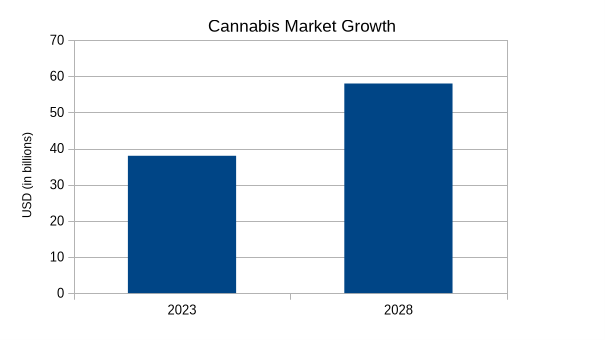
Source: BDSA (formerly BDS Analytics)
One of the most effective ways to stay ahead of fraudsters is by utilizing advanced verification technologies.
In this article, we’ll explore how counterfeiting affects the cannabis industry, why customer trust is at stake, and how proven tools like AlpVision’s solutions help protect consumers and safeguard legitimacy.
The Cannabis Market at a Glance: Growth and Risks
Forecasts for the cannabinoid economy vary widely. Some analysts predict steady growth, while others envision expansion toward nearly $450 billion by 2030.
Regardless of the figure, most agree: the industry is set for sustained double-digit growth.
The main driver is legalization.
As governments move toward decriminalizing marijuana and regulating cannabis derivatives, goods like CBD tinctures, oils, and dietary supplements are gaining mainstream traction.
Yet, with legalization comes complexity. Global supply chains, inconsistent taxation, and fragmented oversight create loopholes. Each gap provides an opening for criminals to exploit trust and push counterfeits into circulation.
Why Customers Want Verification
Before legalization, buyers had little choice but to purchase illicit marijuana, often contaminated or inaccurately labeled.
Today, regulation has created safer environments, but counterfeit risks persist. Vape cartridges, oils, and gummies continue to be targets for imitation.
The 2019 U.S. vape crisis, where thousands of illnesses were linked to unregulated cartridges, is proof of what can happen when the value chain is fragmented.
Consumers want to know that what they’re buying is not only legal but also authentic. Transparent verification systems provide that peace of mind — reducing the chance of buying from unsafe or unauthorized sources.
Vape Cartridges: A Case Study in Counterfeiting
Cartridges for THC and CBD vapes remain among the most commonly falsified categories in the market.
Independent lab tests have revealed contaminants such as heavy metals and pesticides in unverified cartridges. Because imitation suppliers copy logos and containers from trusted operators, most customers cannot tell the difference.
When fake products cause harm, the damage extends beyond public health. Companies risk legal liability, and legitimate businesses suffer reputational harm.
Why Some Buyers Still Take the Risk
Despite the dangers, some customers knowingly buy cheaper, unverified CBD or THC merchandise. Why?
- Price sensitivity: illicit sellers often charge less than licensed dispensaries.
- Misinformation: shady websites market fraudulent oils or gummies as “organic” or “lab tested.”
- Accessibility: in areas with limited retail options, illicit markets step in to fill the gap.
This consumer behavior underscores the importance of anti-counterfeiting technologies. The easier it is to confirm authenticity, the fewer excuses there are to choose unsafe goods.
Global Regulation and Supply Chain Challenges
Differences in regulation add another layer of complexity:
- North America: fragmented rules between U.S. states and Canadian provinces.
- Europe: stricter labeling laws but inconsistent enforcement.
- Asia-Pacific: markets growing quickly but often under-regulated.
Inconsistent oversight creates loopholes that imitation operators exploit. International trade also complicates enforcement, as counterfeit hemp goods can move across borders undetected.
For global businesses, the challenge is ensuring consistent security while meeting local rules. Traceability systems help bridge this gap.
Past Approaches to Protection
Efforts to prevent fraud in the cannabis and hemp market have mirrored strategies in other industries.
Labels and Warnings
Printed warnings, holograms, and visible seals were once considered sufficient. These markings aimed to distinguish legal goods from illegal ones.
The issue? Packaging can be copied. Not every supplier acts ethically, and unauthorized operators still thrive even in regions with regulations.
Scratch-Off Codes
Another early solution was scratch-off codes that buyers could verify by SMS. While promising, these codes came with drawbacks:
- Complex to implement
- Reliant on connectivity
- Easily duplicated
Instead of reassurance, they often created confusion — sometimes even delivering fraudulent “verified” responses through redirected numbers.
Lessons From Other Industries
The cannabis space is not alone in its struggle. Other markets have faced the same battle against imitations:
- Pharmaceuticals: falsified medicines enter global supply chains each year.
- Alcohol: counterfeit spirits are widespread, leading to the adoption of verification apps.
- Cosmetics: knock-off makeup and perfumes flood online marketplaces.
Each example proves that visible security labels are not enough. Scalable, covert solutions that combine authentication with traceability are the only reliable defense.
Next-Generation Authentication for Hemp and CBD
What the industry needs today are not gimmicks, but digital-first anti-counterfeiting systems that provide invisible and reliable safeguards.
That’s where AlpVision’s Cryptoglyph® and Fingerprint® come in.
Cryptoglyph – Protecting Wrappers and Containers
Cryptoglyph is AlpVision’s digital solution for safeguarding packaging.
It embeds thousands of invisible microscopic marks into print layouts. Imperceptible to the eye, these can be verified instantly with a smartphone.
Cryptoglyph can be applied anywhere, even over QR codes that connect to a brand’s app or official authentication portal. This makes it particularly valuable for hemp-based oils, CBD edibles, or vape cartridges where both compliance and trust matter.
By integrating seamlessly into existing printing processes, Cryptoglyph provides robust protection while generating valuable verification data for companies.
AlpVision Fingerprint – Authenticating the Item Itself
While Cryptoglyph protects external wrappers, AlpVision Fingerprint® safeguards the unit itself.
It uses the unique microstructure of each product — such as the natural variations in a plastic-molded pen — as a digital fingerprint.
Each unit can be verified with a simple smartphone scan, making this especially powerful for vape pens, accessories, and molded CBD containers.
Together, Cryptoglyph and Fingerprint® create a two-layer system that stops fakes both at the packaging and product level.
How Authentication Builds Trust
Authentication systems do more than protect against fraud — they create consumer confidence.
Benefits include:
- Stronger customer loyalty
- Safer purchasing decisions
- Reduced reputational risks
- Access to useful data insights
For regulators, widespread use of product verification technology makes it easier to identify weak links in distribution chains and ensure compliance.
Technology Outlook: The Future of Authentication
Looking forward, authentication is expected to become a standard practice in the hemp sector — just as it already is in pharmaceuticals and luxury goods.
Over the next 5–10 years, we may see:
- Wider use of consumer-facing verification apps.
- Integration with blockchain for global traceability.
- IoT-enabled devices that track authenticity in real time.
- Authentication shifting from “value add” to regulatory requirement.
Companies that act early will reduce risk and position themselves as leaders in consumer trust.
Consumer Education: Spotting Red Flags
Technology alone is not enough. Customers also need to know how to identify suspicious merchandise. Some practical tips include:
- Be wary of goods sold at unusually low prices.
- Check whether packaging includes official licensing marks.
- Avoid websites without contact information or return policies.
- Verify QR codes through official apps, not third-party links.
Educating buyers reduces demand for imitations and supports legitimate operators.
Conclusion
As legalization spreads, so do the risks of fraud. Fake CBD oils, falsified hemp derivatives, and imitation vape cartridges endanger both consumers and licensed businesses.
Older defenses like holograms or scratch codes are no longer enough. The industry needs covert, digital-first systems that protect both packaging and products while reassuring buyers.
AlpVision’s Cryptoglyph and Fingerprint® provide a modern solution — delivering scalable, invisible protection that enhances trust.
By adopting smarter safeguards and educating consumers, hemp operators can protect customers, maintain loyalty, and preserve legitimacy in a competitive global market.
To learn more, download our latest white paper on anti-counterfeiting strategies for the cannabis sector.
Download Your Whitepaper