
COUNTERFEIT
PRODUCTS
MARKET
The global counterfeit products market costs hundreds of billions of dollars to brands and the government. AlpVision provides digital invisible anti-counterfeiting and product authentication solutions to Forbes Global 2000 companies and currently helps in the protection of over 30 billion branded products per year across industries and countries.
Our digital invisible technologies can be applied to a variety of branded goods across a broad range of industries. In fact, we’re able to protect almost any object in the world.

Highly secure against copying

AUTHENTICATE WITH
A MOBILE PHONE

Simple and inexpensive to implement

INVISIBLE SECURITY

Instant positive authentication
Global Counterfeit Products Market Overview
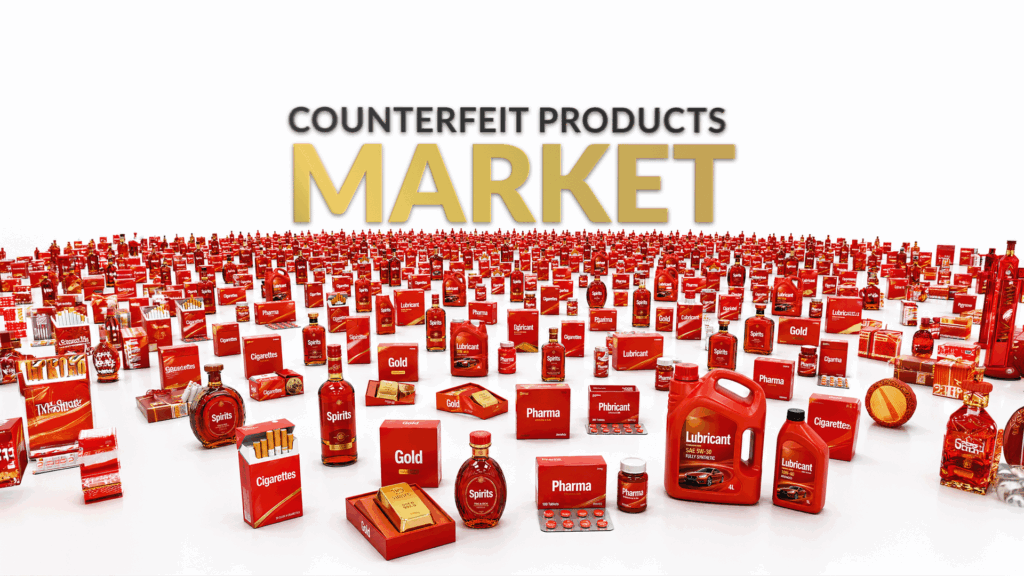
The global counterfeit products market exceeds USD 450 billion annually, representing roughly 2.3% of global trade, according to reports from the OECD and the European Union Intellectual Property Office (EUIPO).
Counterfeiting affects a wide range of industries, including pharmaceuticals, luxury goods, automotive parts, electronics, and alcohol. The growth of e-commerce, complex global supply chains, and sophisticated criminal networks has made counterfeit products easier to distribute and harder for brand owners to detect.
Here are some key industries that trust AlpVision to keep their products secure and fight counterfeit problems.
INDUSTRIES WE PROTECT AGAINST COUNTERFEITING
COUNTERFEIT PHARMACEUTICALS
Pharmaceutical brands have the biggest problem of securing their products due to the safety of consumer health and the regulations by law enforcement. Fake medicines and other counterfeit pharmaceutical products lack the required active ingredients in sufficient quantity, or worse, contain harmful ingredients. This gives the consumers a false sense of protection.
AlpVision’s patented security solutions help by integrating into your existing production process without any change. What’s more, your packaging can remain the same with no modifications in branding, as AlpVision’s technology doesn’t leave any visible marking or contain any additional consumables.
Read our complete market study on pharmaceutical counterfeits.
Discover AlpVision’s Solutions To Pharmaceutical Counterfeiting

COUNTERFEIT TOBACCO PRODUCTS
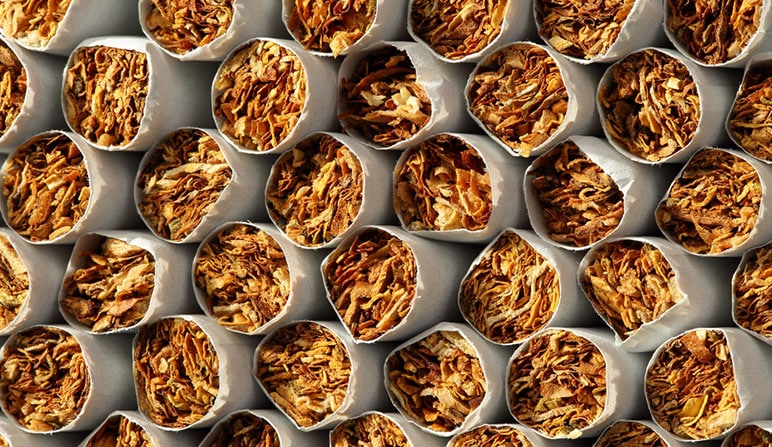
According to a recent report, 11.6 percent of the global cigarette trade is estimated to be illicit. This translates to a loss of revenue of more than $40 billion yearly for the tobacco products market. In China alone, more than 400 billion counterfeit cigarettes are produced every year and exported to other countries.
While the tobacco industry is heavily regulated by law enforcement in several countries, counterfeiters still find a way to carry out their trade.
This problem is because tobacco smuggling and counterfeiting are low-risk and high-reward tasks for counterfeiters and illegal sellers. They create a replica of the goods, including minor details. This is why tobacco brands need to adopt anti-counterfeiting technology that goes beyond the outer markings like barcodes or holograms on the packaging.
AlpVision provides a covert solution that can be integrated into your current production process. The technology can’t be replicated by the counterfeiters, protecting your revenue, brand reputation, and consumer health.
Learn more in our in-depth market study on tobacco counterfeiting.
Discover AlpVision’s Solutions To Tobacco Counterfeiting
COUNTERFEIT GOVERNMENT DOCUMENTS
AlpVision currently protects millions of valuable documents worldwide from forgery, tampering, and counterfeiting. We protect a range of documents such as bank notes, bonds, trade agreements, international treaties, and much more.
What sets AlpVision apart in the field of document security is our ability to offer the printing industry a covert security solution that requires no special paper or ink. It can be integrated with your existing IT software and third-party applications, including any document processing and automation tools.
You don’t need to invest in any hardware when applying our security feature, making it the most value-for-money solution in the market.
Contact us to find out how we can help you.
Discover AlpVision’s Solutions To Government Documents Counterfeiting


COUNTERFEIT PRECIOUS METALS
Tungsten-filled gold bars, fake coins, and even jewelry counterfeits – the criminal energy of counterfeiters’ business is nearly without limits. The problem of precious metal counterfeiting is growing with the increase in online sales on third-party websites, as consumers can’t check the quality of the fake items before they purchase.
Technical solutions to effectively protect precious metal products and goods are rare and difficult to implement. AlpVision’s Fingerprint is a game-changer in this industry.
Without modifying the product or requiring specific production steps, Fingerprint protects precious metal products in a highly secure, easy-to-implement, and cost-effective way. Beyond product protection, the features also help to track and trace certificates of origin, and more.
Read our complete market study on precious metals.
Discover AlpVision’s Solutions To Precious Metals Counterfeiting
COUNTERFEIT WINE & SPIRITS
Counterfeit alcohol remains the second most seized commodity due to intellectual property infringement and illicit trade. Legal departments like the United States HSI, INTERPOL, and Europol are always on the lookout for counterfeit dealings. But counterfeiters find new ways to distribute fake alcoholic beverages, including producing unbranded low-cost alcoholic products, to avoid trademark infringement.
In an effort to combat the rise of wine and liquor fraud, AlpVision offers the industry a patented security solution that requires no visible markings, no additional consumables, no special reading devices, and no changes to your original production process. Our Crytoglyph® technology is an invisible marking that can be applied to spirits, aluminum closures, and tin capsules using regular visible varnish and a standard printing process.
Read our in-depth market study to learn more.
Discover AlopVision’s Solutions To Wine & Spirits Counterfeiting

COUNTERFEIT LUBRICANTS
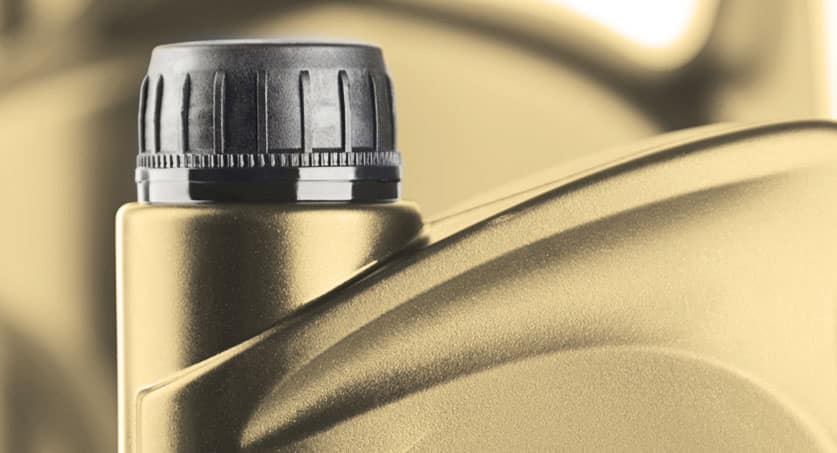
Counterfeiting lubricants and fake engine oils have become a lucrative business over the past few years. Refilling, copying, dilution, and even brand fraud are just a few of the problems encountered. The lubricant industry has woken up, realizing that counterfeit goods sold have a disastrous impact on brand image and value, as well as their consumers.
Modern ways to protect lubricants rely on the protection of the containers, such as bottles and barrels. AlpVision’s Fingerprint, Cryptoglyph, or a combination of both are ideal solutions to help protect the containers in a cost-effective, easy-to-deploy, and highly secure way.
Read our complete market study about lubricant counterfeiting.
Discover AlpVision’s Solutions To Lubricants Counterfeiting
PROTECTING PRODUCTS IN THE GLOBAL COUNTERFEIT MARKET

THE SCOPE OF ALPVISION’S AUTHENTICATION SOLUTIONS
AlpVision’s digital invisible technologies can be used to protect any packaging or the product itself.
Packaging examples include cartons, not only for the pharma industry but also for:
- Pet medications,
- Labels and leaflets,
- Blister packs,
- Authenticity certificate (for instance, in the watch industry) and,
- Collectible cards.
We help in the protection of products like bottles and caps, electrical appliances, mechanical parts, imaging supplies, and most plastic molded products like cannabis vape pens, precious metals, batteries, car parts, casino chips, food supplements, and even shoes.
In fact, our solutions can be implemented to protect almost all manufactured products you can think of.
Would you like to see how we can help to protect your product?
Contact Us
Frequently Asked Questions
What industries are most affected by counterfeit products?
The industries most affected by counterfeit products are:
- Pharmaceuticals
- Tobacco
- Alcohol
- Luxury goods
- Automotive parts
- Electronics
- Lubricants
- Precious metals
Counterfeiters target these industries because the products carry strong brand recognition, high resale value, and large global distribution.
What country produces the most counterfeit goods?
According to a report from the OECD, China is the primary source of counterfeit goods seized in international trade. Along with China, Hong Kong is another major source of counterfeits.
Read more about counterfeit goods from China here.
How do counterfeit products enter global markets?
Counterfeit goods enter global markets through multiple channels, including:
- Unauthorized suppliers that introduce counterfeited goods into legitimate supply chains
- Parallel trade and grey markets, where products are sold outside official distribution channels
- Online marketplaces and platforms, including Amazon, where counterfeit products are sold by third-party sellers
- Cross-border e-commerce platforms that allow counterfeiters to scale globally
- Imported shipments that bypass customs, often mislabeled or undervalued to avoid detection
Counterfeiters use complex shipping routes to move goods through international supply chains and bypass detection. To make these products appear authentic, they copy packaging, labels, and security markings before the goods are distributed and sold to end consumers, often at a lower price than genuine products.
Why are counterfeit products difficult to detect?
Detecting counterfeit products is difficult because of the precise replication of packaging, labels, and security markings. Features such as holograms, barcodes, QR codes, and printed seals provide limited protection because counterfeiters can copy them or transfer them onto fake products. As a result, many brands are turning to covert authentication technologies that embed security directly into the packaging or product itself.
Why is the counterfeit products market growing?
The counterfeit products market continues to grow due to a combination of economic and market factors:
- Strong economic incentives make counterfeiting a high-profit, low-risk activity for criminal networks
- Lower price points attract consumers, allowing counterfeiters to scale quickly
- Expansion of e-commerce makes it easier to distribute counterfeit goods globally
- High demand for branded products creates consistent opportunities for fake alternatives
- Growth in high-risk categories, such as counterfeited drugs, increases both market size and safety concerns
As global trade and online platforms continue to expand, the counterfeit products market will keep growing unless stronger enforcement and authentication measures are implemented.
How do anti-counterfeiting technologies work?
Anti-counterfeiting technologies work by embedding security features into products or packaging for manufacturers and inspectors to verify authenticity. Depending on the technology, the anti-counterfeiting features may include invisible markers or digital identifiers.
Can anti-counterfeiting technology be applied without changing packaging?
Yes. Some authentication technologies, like that of AlpVision’s, integrate directly into your existing printing or manufacturing processes. These solutions embed invisible security features into packaging components like labels, cartons, closures, or molded parts.
Would you like to see how we can help to protect your product?
Contact us!
WHAT OUR CLIENTS SAY
