
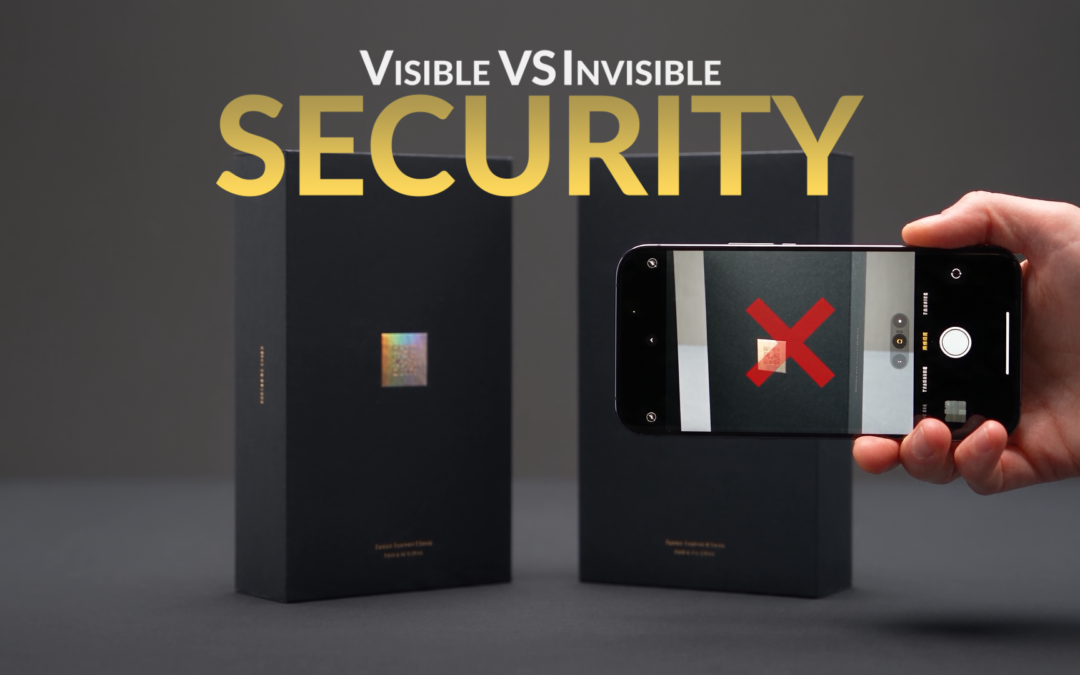
In anti-counterfeiting and product authentication, security features are generally classified as visible or invisible. Visible, or overt, features can be identified with the naked eye and are often designed for quick inspection. Invisible, or covert, features remain concealed and require a specific tool or method for authentication.
The choice raises an important question: should a security feature be obvious enough for consumers and other users to identify, or should it remain hidden from counterfeiters attempting to analyze and reproduce it?
Each approach serves a different purpose. Visible features allow quick checks and can deter counterfeiters, but they are also easier to study and copy. Invisible features are harder to find, analyze, and reproduce, which makes them more suitable for discreet product authentication.
In this article, we compare visible and invisible security features to help you choose the right option for your products.
Visible vs. Invisible Security Features: Quick Comparison
Before looking at each type in detail, here’s how visible and invisible security features compare:
| Factor | Visible security features | Invisible security features |
| Authentication | Checked through visual or physical inspection | Checked using a smartphone, reader, or another method |
| User access | Usually available to anyone who knows what to inspect | Can be used by consumers or restricted to authorized users, depending on the solution |
| Exposure to counterfeiters | Easy to locate and study | Harder to find, analyze, and reproduce |
| Packaging impact | May add visible elements to the design | Can remain hidden without changing the product’s appearance |
| Manufacturing compatibility | May require special labels, inks, or materials | Requirements vary; some solutions work with existing processes and consumables |
| Best suited for | Quick visual checks, reassurance, and deterrence | Discreet authentication and counterfeit detection |
| Examples | Holograms, color-shifting inks, tamper seals | AlpVision Fingerprint, Cryptoglyph, taggants |
What Are Visible Security Features?
Visible security features, also known as overt security features, are elements that users can identify with the naked eye. They are added to a product, label, or packaging so consumers, retailers, and supply chain teams can perform an initial authenticity check without specialized equipment.
Some features can be recognized immediately. Others require the user to tilt, touch, or hold the product against the light. A hologram, for example, displays different effects when viewed from different angles, while color-shifting ink changes color as the viewing angle changes.
Examples of Visible Security Features
Common visible security features include:
- Security labels: Labels applied to a product or package that may include special printing, serial numbers, or other authentication elements.
- Holograms: Display images, colors, or effects that change when viewed from different angles.
- Color-shifting inks: Change from one color to another when the product or document is tilted.
- Visible security pigments: Create distinctive colors, reflections, or optical effects that users can recognize under normal lighting.
- QR codes: Allow users to scan a product and access authentication or product information.
- Tamper-evident seals: Show visible signs when a package has been opened, removed, or altered.
Purpose of Visible Security Features
Visible features give users a recognizable point of reference and signal that a product is protected. This can reassure consumers and deter basic copying. However, it also gives counterfeiters something they can locate, study, and imitate.
However, these effects depend on whether users know what to check and can distinguish the genuine feature from an imitation. Research on euro banknotes illustrates this problem: a De Nederlandsche Bank paper reported that while 75% of people knew euro banknotes contained a watermark, only 5% knew which image the watermark should display.
Advantages of Visible Security Features
Visible security features offer several practical advantages:
- Quick authentication: Users can inspect the feature at the point of purchase or anywhere along the supply chain to detect counterfeit goods.
- No specialized equipment: Most visible features can be checked with the naked eye, although users may need to tilt, touch, or hold them against the light.
- Consumer involvement: Holograms, watermarks, and other recognizable features give consumers something specific to check before buying or using a product.
- Visible deterrence: Their presence shows that the product is protected and may discourage counterfeiters looking for an easier target.
- Simple supply chain checks: Retailers and distributors can perform an initial inspection without accessing a dedicated authentication system.
Limitations of Visible Security Features
Their visibility also creates several limitations:
- Easier to study: Counterfeiters can locate the feature, examine how it works, and attempt to reproduce it.
- Convincing copies can mislead users: A counterfeit feature may not be technically identical to the original. It only needs to look genuine enough to the person checking it.
- Reliance on human judgment: Users must know where to find the feature and how the genuine version should look or behave. This can lead to inconsistent results.
- Changes to the packaging: Holograms, seals, special inks, and other additions may affect the original design.
- Additional production requirements: Some features require special materials, equipment, or application steps, which can increase cost and manufacturing complexity.
What Are Invisible Security Features?
Invisible security features, also known as covert security features, are hidden elements used to authenticate products, packaging, or documents. They can’t be identified through ordinary visual inspection and require a specific tool or method for detection.
The authentication method depends on the anti-counterfeiting technology. Some features require UV light, magnification, or a dedicated reader. Others can be checked with a standard smartphone.
A feature being invisible doesn’t mean that only trained or authorized users can authenticate it. It means that counterfeiters can’t easily find or examine the feature simply by looking at the product.
Examples of Invisible Security Features
Common invisible security features include:
- AlpVision Cryptoglyph: An invisible digital marking made of microscopic dots. It can be integrated into printed packaging and authenticated using a standard smartphone.
- AlpVision Fingerprint: Uses the naturally occurring surface details of a product or component for authentication. It doesn’t require an added marking or visible change.
- Hidden digital watermarks: Machine-readable information embedded into packaging artwork or other printed content without creating an obvious visible code.
- Covert markers: Hidden materials such as UV- or infrared-responsive inks, microscopic taggants, chemical markers, or DNA markers. The detection method depends on the type of marker used.
Purpose of Invisible Security Features
Invisible security features allow brands to protect products without adding an obvious security element. This is useful when packaging design matters or when a visible label, code, or marking could interfere with the product’s appearance.
Depending on the solution, brands can make authentication available to consumers or restrict it to selected users, such as distributors, investigators, or internal brand-protection teams. This allows the same type of security feature to support different authentication strategies.
Advantages of Invisible Security Features
Invisible security features offer several advantages when you need to authenticate products without revealing how they are protected:
- Harder to find and reproduce: Counterfeiters have less information about where the feature is located and how it works.
- No visible effect on the product: The feature can protect a product without competing with its packaging, branding, or design.
- Flexible user access: Some solutions allow consumers to detect counterfeits with a smartphone, while others restrict access to authorized users.
- More consistent checks: A digital system or detection tool can provide a clear authentication result instead of relying only on visual judgment.
- Manufacturing compatibility: Some invisible technologies work with existing materials, processes, and production equipment.
- Supply chain visibility: Digital authentication systems can record when and where checks occur, helping brands identify suspicious products and locations.
Limitations of Invisible Security Features
The limitations depend on the technology, the authentication method, and how the system is deployed:
- A detection method is required: Users need a smartphone, reader, light source, application, or another tool to authenticate the feature.
- No immediate visual reassurance: Consumers may not know that the product is protected unless the brand explains how to check it.
- Limited visible deterrence: Because counterfeiters can’t see the feature, it may not discourage them from attempting to copy the product.
- Access or training may be necessary: Some systems require controlled access or user training, although consumer-facing smartphone solutions can reduce this barrier.
- Implementation requirements vary: Certain technologies require special inks, materials, readers, or production changes. Others can work with existing processes and consumables.
Which Type Provides Better Protection Against Counterfeiting?
No security feature can stop someone from producing a counterfeit. Instead, it makes copying more difficult and helps users detect fake products before they reach consumers.
Visible Features: Deterrence With More Exposure
Visible features support deterrence and first-level checks. They increase the effort needed to create a convincing copy and give consumers, retailers, and supply chain teams something they can inspect immediately.
At the same time, they give counterfeiters a model to study. A counterfeiter can examine the feature’s location, appearance, and behavior. The imitation may not need to be technically identical. It only needs to look genuine enough to pass a visual check.
This is why visual resemblance is not the same as reliable authentication. Results can vary based on the user’s knowledge, the inspection conditions, and the quality of the imitation.
Invisible Features: Stronger Concealment
Invisible features hide the authentication mechanism. Counterfeiters can’t easily determine what they need to reproduce or where the feature is located.
However, invisibility alone doesn’t make a feature secure. The technology must also be difficult to reproduce and produce a clear, repeatable genuine-or-fake result.
Why Brands Combine Visible and Invisible Protection
A strong brand protection strategy doesn’t expect one security feature to do everything. Visible and invisible features address different risks and support different users.
- Visible features provide an immediate point of reference. Consumers, retailers, and supply chain teams can perform quick checks, while the feature’s presence can reassure buyers and deter basic copying.
- Invisible features provide stronger confirmation. They conceal the authentication mechanism and allow users to verify a product when visual inspection is not enough.
- Digital systems provide intelligence. When authentication connects to serialization, track and trace, or a cloud platform, you can monitor checks and identify suspicious products, locations, or distribution patterns.
These layers work together because each one covers a limitation of the others. A visible feature is easy to use but also exposed to counterfeiters. An invisible feature is harder to study but requires a method of detection. A digital system provides useful data but still needs a reliable connection to the physical product.
Industry Applications of Visible and Invisible Security Features
Different industries face different forms of counterfeiting. The table below shows whether visible, invisible, or combined protection is generally the better starting point.
| Industry | Main counterfeit risks | Best-fit approach | Why |
| Pharmaceuticals | Falsified contents, package reuse, and tampering | Combined | Visible features show tampering, while invisible features provide stronger product authentication. |
| Cosmetics | Copied packaging, unsafe ingredients, refilling, and grey market diversion | Combined | Visible features reassure consumers, and invisible authentication helps you detect fake, refilled, or diverted products. |
| Luxury goods | High-quality replicas and reuse of genuine packaging | Invisible-led or combined | Invisible features preserve the design and are harder to imitate. A visible feature can provide consumer reassurance where needed. |
| Electronics | Relabeled, substituted, or low-quality components | Invisible-led | Authentication should connect to the component itself rather than relying only on packaging or visible labels. |
| Food and beverage and consumer goods | Adulteration, substitution, package reuse, and refilling | Combined | Visible seals reveal tampering, while invisible features authenticate the label, closure, package, or product. |
| Industrial products | Counterfeit parts, unauthorized substitution, and supply chain infiltration | Invisible-led | Hidden product-level authentication is harder to copy and supports checks throughout complex supply chains. |
How to Choose Between Visible and Invisible Security Features
The right choice depends on the product, the counterfeit threat, and how authentication will work in practice. Consider the following eight factors:
- Product value: Consider the financial, safety, and reputational impact of a counterfeit—not just the product’s selling price. A low-cost product may still require strong protection if it is sold at high volumes or creates serious safety risks.
- Risk profile: Visible features may be enough to deter basic copying. Products targeted by organized or technically capable counterfeiters usually require authentication that is harder to find, study, and reproduce.
- Consumer involvement: If consumers need to check the product themselves, you can use a recognizable visible feature or an invisible feature that works with a smartphone. If authentication is limited to internal teams, access to the feature and verification system can remain controlled.
- Supply chain: Identify where checks will take place and who will perform them. Manufacturers, distributors, customs officers, retailers, investigators, and consumers may need different authentication methods.
- What needs protection: Decide whether you need to authenticate the product, packaging, label, closure, or component. Protecting the package alone may not detect refilling or product substitution.
- Manufacturing compatibility: Determine whether the feature requires new labels, inks, materials, readers, or production steps. Some solutions can work with existing processes and consumables.
- Authentication data: If you need to identify suspicious locations, repeated failures, or distribution patterns, consider a solution connected to a cloud platform, serialization, or track and trace.
- Total cost: Include equipment, integration, training, maintenance, consumables, and the time required to perform each check.
When Should Companies Choose Invisible vs. Visible Protection?
As a general guide:
- Choose visible security features when you need quick recognition, consumer reassurance, and deterrence.
- Choose invisible security features when you need discreet authentication that is harder for counterfeiters to study.
- Choose a combined approach when different users need different levels of authentication or when one feature can’t address the full risk.
The best solution is one that matches the product’s risk profile, fits the manufacturing and supply chain environment, and produces a clear authentication result without unnecessary cost or complexity.
Here’s a quick comparison table of different technologies:
| Technology | Type | Best suited for | Authentication method | Manufacturing impact | Main consideration |
| Cryptoglyph | Invisible | Labels and printed packaging | Smartphone | Works with standard printing processes and consumables | Protects the printed element |
| Fingerprint | Invisible | Molded, stamped, or tooled products and components | Smartphone | No added marking or material | Requires a suitable manufactured surface |
| Holograms | Visible | Consumer goods and deterrence | Visual inspection | Requires a label, foil, or added element | Exposed to imitation |
| Security pigments | Visible or invisible | Printed packaging and documents | Visual check, light source, or reader | Requires special pigments or inks | Detection depends on the pigment |
| QR codes | Visible | Consumer engagement, identification, and serialization | Smartphone | Requires a printed code and digital system | Standard QR codes can be copied |
| Tamper-evident seals | Visible | Detecting package opening or alteration | Visual inspection | Requires an added seal or material | Shows tampering but may not prove authenticity |
| Covert markers | Invisible | Controlled supply-chain checks | Light source, reader, or testing method | Often requires special inks, taggants, or materials | May require dedicated equipment |
How AlpVision Applies Invisible Product Authentication
As discussed above, invisible security features are harder for counterfeiters to find and study. However, they still need to produce a clear authentication result, remain easy for legitimate users to check, and fit existing manufacturing processes.
AlpVision addresses these requirements through two invisible, smartphone-based product authentication technologies.
1. Cryptoglyph for Printed Packaging
Cryptoglyph adds an invisible pattern of microscopic dots to labels, packaging, and other printed materials. The pattern becomes part of the existing artwork and can be applied using standard printing processes and consumables.
Users can use a smartphone application to receive an authentication result. This allows brands to conceal the security feature without adding a visible code, label, or element that affects the packaging design.
2. Fingerprint for Products and Components
AlpVision Fingerprint uses microscopic product surface irregularities created naturally during manufacturing. These details act as a fingerprint for molded, stamped, or tooled products and components.
The smartphone application compares the product’s surface with stored reference images to determine whether it is genuine. Since the product’s existing surface provides the security information, no marking or additional material is required.
Both technologies show that invisible authentication doesn’t have to mean difficult authentication. Consumers or authorized supply chain users can perform checks with a smartphone, while the security feature remains concealed from counterfeiters.
To learn more, download the AlpVision whitepaper and compare visible and invisible technologies. See how Cryptoglyph and Fingerprint enable discreet authentication, and choose the right solution for your products and supply chain.
Download Your Whitepaper