
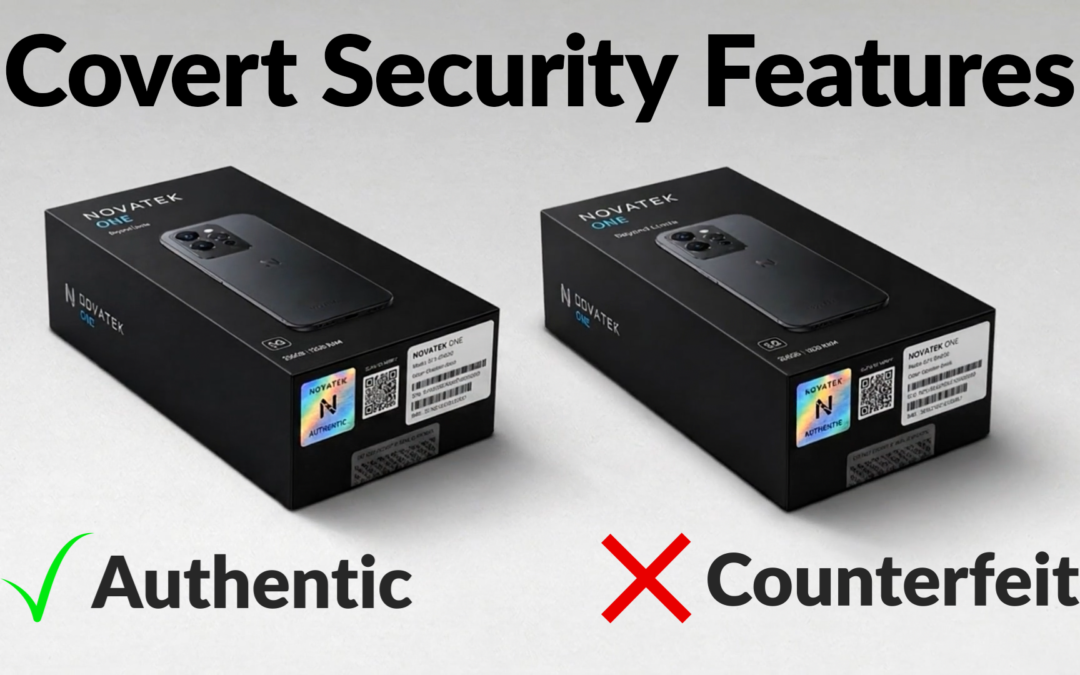
Covert security features are among the most secure features. However, other factors must be considered while choosing the most appropriate features, such as target audience, deployment complexity, and cost. Discover below the most well-known features and compare them to your needs.
What Are Covert Security Features?
Covert security features are hidden authentication elements embedded into your products, packaging, or labels to help you detect counterfeits without revealing how your protection works. These anti-counterfeiting features stay invisible and difficult to identify, making them harder for counterfeiters to replicate.
Modern technologies range from invisible digital markers and forensic taggants to hidden print structures and smartphone-detectable authentication systems.
Covert vs. Overt Security Features: Differences
Overt features are visible authentication elements designed to reassure consumers and support quick visual verification. Examples include holograms, watermarks, color-shifting inks, tamper-evident seals, and visible QR codes.
On the other hand, covert features stay hidden from consumers and counterfeiters, allowing you to authenticate items without revealing how the protection works. Examples include invisible digital watermarking, UV-reactive elements, and technologies such as AlpVision Cryptoglyph and AlpVision Fingerprint.
| Aspect | Overt Security Features | Covert Security Features |
| Visibility | Visible to the naked eyes | Invisible to the naked eyes |
| Purpose | Supports visual verification and consumer trust | Enables hidden authentication |
| Primary Benefit | Helps consumers recognize and trust authentic items | Strengthens counterfeit detection and investigation |
| Counterfeiter Exposure | Easier to study and imitate | Harder to identify and replicate |
| Authentication Method | Visual inspection | Specialized tools, apps, or scanners |
| Common Examples | Holograms, visible QR codes, color-shifting inks | Invisible digital markers, taggants, hidden print structures |
Read more: Can counterfeiters imitate covert and overt solutions?
Why Brands Are Moving Toward Covert Security Features
Overt features help consumers trust your goods, but they also expose your protection strategy to counterfeiters. That is why many fake products today appear authentic at first glance. You need covert features because they are:
Uncertain for Counterfeiters
These stay hidden, making them significantly harder to identify, analyze, and replicate. If the replicators don’t know what protects your product, copying it becomes far more difficult.
Difficult and Expensive to Replicate
Modern authentication technologies are not easy to recreate. For example, AlpVision’s anti-counterfeiting technology has years of research and patented methods behind it. Replicating such mechanisms requires significant technical expertise, time, and financial investment.
Better at Field Authentication
Modern technologies also make authentication easier in the field. Brand inspectors, customs officers, and investigators can verify items quickly using smartphone-based or scanner-based authentication tools.
This helps you identify counterfeit goods faster and respond before they spread further into the market.
Common Types of Covert Security Features
There are different types of covert security technologies that protect goods in different ways. Some rely on hidden digital authentication, while others use microscopic materials, invisible markings, or the physical structure of the product itself. Here are some examples:
Invisible Digital Markers
Invisible digital markers are embedded directly into the packaging without changing their appearance. These patterns can be detected using dedicated smartphone apps, providing fast verification in the field.
For example, AlpVision Cryptoglyph can integrate covert authentication directly into an existing label without changing its visual appearance.
Product-Intrinsic Authentication
Some methods authenticate products using the unique microscopic surface structure of the item or packaging itself. Since these natural patterns are extremely difficult to duplicate exactly, they can serve as a built-in authentication layer.
AlpVision Fingerprint is an example of this technology. It uses the microscopic randomness already present on a product’s surface as a unique identifier for authentication.
Forensic Taggants
Forensic taggants are chemical or microscopic identifiers added to commodities, inks, coatings, or packaging materials. These features often require specialized readers or laboratory analysis for authentication.
They are commonly used in high-security industries, including banknotes. Some covert technologies also rely on laser verification methods for advanced authentication and forensic analysis.
UV and Infrared
UV and infrared remain invisible under normal lighting conditions and become visible only under specific light sources.
Brands often use these features on packaging, documents, and seals to support covert verification during inspections. These are also used to protect sensitive document workflows against forgery and unauthorized reproduction.
Microtext and Hidden Print Structures
Microtext and print structures use extremely small text or microscopic design elements that are difficult for counterfeiters to reproduce accurately. While an outdated technology now, microprinting used to be difficult to reproduce accurately using standard printing equipment.
These features are commonly integrated into packaging, labels, and secure printed materials as an additional covert authentication layer.
Security Levels of Covert Features
The security of a covert feature depends on two key factors:
- Duplication resistance: How difficult it is to replicate the feature itself
- Forgery resistance: How difficult it is to create a convincing lookalike capable of fooling users or authentication systems
Here are the different levels:
| Security Level | Characteristics | Covert Technology Example |
| Low Security | Easier to reproduce or imitate once identified | Thermochromic inks |
| Medium Security | Stronger protection, but still dependent on identifiable materials or physical components | Fluorescence, RFID tags |
| High Security | Difficult to duplicate due to proprietary algorithms, microscopic randomness, hidden digital structures, or advanced authentication methods | AlpVision Fingerprint, Cryptoglyph, Raman spectroscopy, secured QR codes |
Low Security
Provide basic invisible authentication, but are generally easier to reproduce or imitate over time. Examples include:
- Thermochromic inks
Medium Security
Offer stronger protection, but may still depend on physical materials or identifiable authentication methods. Examples include:
- Fluorescence
- RFID
High Security
Significantly harder to duplicate due to proprietary algorithms, microscopic randomness, digital structures, or advanced authentication methods. Examples include:
- AlpVision Fingerprint
- Cryptoglyph
- Raman spectroscopy
- Secured QR codes
Cost related to Covert Security Features
The cost of covert security features typically comes down to three factors:
- Reader costs
- Cost per protected item
- Deployment costs
Reader Costs
Reader costs can vary significantly depending on the technology. Raman spectroscopy, for example, often requires expensive equipment, while fluorescence systems may use lower-cost readers. In contrast, technologies such as AlpVision Fingerprint, Cryptoglyph, and secured QR codes use smartphones for authentication. This reduces hardware costs because the device is already used for multiple business applications beyond authentication.
Cost Per Protected Item
The cost per protected item is another major consideration. Methods such as RFID and fluorescence usually carry higher per-item costs because they rely on additional physical components or materials. RFID costs, for instance, increase directly with the number of products since every protected item requires a chip.
Deployment Costs
Technologies based on software licensing instead of physical consumables scale more efficiently at high volumes. That is why solutions such as AlpVision Fingerprint, Cryptoglyph, and secured QR codes become particularly cost-effective for large-scale programs.
How to Choose the Right Covert Security Feature
The right covert security feature depends on three main factors:
- Target audience: Who needs to authenticate
- Product type: What you want to protect
- Deployment complexity: How difficult the deployment will be
Some are designed for internal investigations and customs inspections, while others are suitable for consumer-facing authentication. Similarly, certain features work best on packaging and printed materials, while others are designed for authenticating the physical product itself.
Selecting Your Covert Security Based On Your Target Audience
Depending on your anti-counterfeit strategy, authentication may be performed by:
- Internal and external inspectors
- Customs and enforcement agencies
- Consumers
Internal inspection teams and customs authorities can typically use all covert authentication technologies because they have access to specialized readers, scanners, or verification tools.
Consumers, however, require methods that are simple and accessible. In most cases, this limits consumer authentication to solutions such as:
- AlpVision Fingerprint
- Cryptoglyph
- Secured QR codes
- Thermochromic inks
These mechanisms only require a smartphone or simple visual interaction, making them practical for large-scale consumer verification programs.
| Target Audience | Suitable Covert Technologies | Why They Fit |
| Internal and external inspectors | All listed technologies | Inspectors can use specialized readers, scanners, and authentication tools |
| Customs and enforcement agencies | All listed technologies | Customs teams typically have access to dedicated verification equipment |
| Consumers | AlpVision Fingerprint, Cryptoglyph, secured QR codes, thermochromic inks | These technologies only require a smartphone or simple visual interaction |
Choosing a Covert Security Based on Product Type
The type of product or material you want to secure also affects which covert technology is most suitable.
In most cases, brands need to protect:
- Printed items parts such as packaging and cartons
- The physical good itself
- Digital products
Printed packaging and labels are commonly protected using:
- Cryptoglyph
- Fluorescence
- Secured QR codes
- Thermochromic inks
Physical items, on the other hand, are better suited for technologies such as:
- AlpVision Fingerprint
- Raman spectroscopy
- RFID
| Product Type | Suitable Technologies |
| Printed packaging, labels, cartons, and product artwork | Cryptoglyph, fluorescence, secured QR codes, thermochromic inks |
| Physical products | AlpVision Fingerprint, product fingerprint authentication, Raman spectroscopy |
Choosing a Covert Security Based on Deployment Complexity
Deployment complexity varies significantly between covert authentication technologies. Some solutions integrate into existing products and packaging with minimal operational impact, while others require specialized materials, hardware, or major supply chain changes. Here’s an overview:
| Cover Technology | Deployment Complexity | Reason |
| AlpVision Fingerprint | Low | Uses the intrinsic microscopic structure of the product itself without additional materials |
| Cryptoglyph | Low | Integrates into existing printed artwork without changing the printing process |
| Thermochromic inks | Medium | Requires specialized inks during production |
| Secured QR codes | Medium | Elements may need dynamic generation during QR code creation |
| Raman spectroscopy | High | Often requires laboratory testing and destructive analysis |
| Fluorescence | High | Requires specialized materials and detection equipment |
| RFID tag | High | Requires electronic RFID components and supply chain integration changes |
Industries That Benefit Most From Covert Security Features
The global counterfeit products market includes nearly every industry, but some sectors face significantly higher exposure due to item value, safety concerns, and supply chain complexity. Covert security features help brands in these industries authenticate products without revealing how their protection works:
- Pharmaceutical and Healthcare: Pharmaceutical counterfeiting directly threatens patient safety and exposes pharma companies to serious regulatory and reputational risks.
- Cosmetics and Personal Care: Counterfeit cosmetics imitate authentic packaging extremely well, making visual verification unreliable. Fake goods may contain unsafe ingredients that damage both consumer trust and brand reputation.
- Food and Beverage: Counterfeit food and beverage products create major safety and liability concerns, especially in premium and export-driven markets.
- Lubricants and Industrial Components: Counterfeit lubricants and industrial components, like counterfeit airplane parts, can cause equipment failures, operational disruptions, and safety issues.
- Luxury and Consumer Goods: Luxury brands face constant counterfeiting due to high product value and strong consumer demand. Many counterfeit items now closely imitate packaging.
- Wine and Spirits: Counterfeit wines and alcoholic beverages can damage brand reputation, impact collector markets, and create serious consumer safety risks.
- Precious Metals: Counterfeit precious metals, including gold and silver, create major financial risks for refiners, dealers, investors, and collectors. Fraudulent bars and coins can enter legitimate distribution channels with convincing packaging and documentation.
- Medical Devices: Counterfeit medical devices compromise patient safety, treatment outcomes, and regulatory compliance. Complex global supply chains also make device authentication increasingly difficult.
- Tobacco: Illicit and counterfeit tobacco products continue to create major revenue losses and compliance challenges for manufacturers and governments.
Challenges of Traditional Covert Technologies
Traditional authentication technologies often introduce operational challenges that make adoption difficult (and expensive) across large merchandise portfolios and global supply chains. Here are the challenges most brands face when deploying traditional covert solutions:
- High implementation costs: Some processes require specialized inks, custom materials, dedicated hardware, or production line modifications. These added requirements can increase implementation costs significantly, especially for brands operating across multiple packaging formats and manufacturing sites.
- Operational complexity: Traditional systems often depend on specialized readers, laboratory testing, or highly trained personnel for authentication. This slows down inspections, complicates field verification, and limits how widely authentication tools can be deployed.
- Scalability limitations: Many mechanisms work well in controlled environments but become difficult to scale across high-volume production and global distribution networks.
How AlpVision’s Modern Technology Works
AlpVision offers modern covert authentication technologies that reduce the operational and financial barriers associated with traditional security features, as they:
- Require no special inks or consumables: AlpVision works with existing packaging materials and printing processes, eliminating the need for expensive custom inks or additional consumables.
- Don’t need major production changes: Integrate directly into existing packaging or products without requiring manufacturing line changes or workflow disruptions.
- Offer easier global scalability: AlpVision is designed for your existing production environments and is easier to deploy across multiple suppliers, packaging formats, and international manufacturing sites.
- Support smartphone product authentication: Use smartphones instead of specialized scanners or laboratory equipment, making field verification faster and more accessible.
- Allow faster investigations and inspections: Easier product authentication methods help brand protection teams, customs officers, and investigators verify suspicious products more efficiently in real-world conditions.
Implement Covert Security with AlpVision
Choosing the right security feature isn’t just about adding another brand protection strategy. It’s about implementing authentication that fits your products, supply chain, operational requirements, and long-term anti-counterfeit strategy.
AlpVision helps brands deploy covert authentication technologies that support real-world scalability, field verification, and stronger counterfeit detection without introducing unnecessary complexity into existing packaging and manufacturing workflows.
Since choosing a covert security feature is a complex process, we created a white paper to help you through the process. Download it here or contact us to find a solution that fits your business needs.
Contact Us
Frequently Asked Questions
How do covert security features support brand protection?
● Detect counterfeit goods earlier: Authentication allows you to identify suspicious items before they spread further through the market. It helps you investigate counterfeit goods circulating across web marketplaces and e-commerce platforms, as well.
● Detect counterfeit goods in the supply chains: This is often difficult as it involves multiple distributors, resellers, and third-party vendors. Security features help you verify authenticity at different points in the supply chain without changing packaging appearance or slowing operations.
● Support enforcement actions: Authentication gives investigators and enforcement teams stronger evidence during anti-counterfeit operations.
● Protect consumer trust: Consumers expect authentic and safe goods. When counterfeit products reach the market, your brand reputation can suffer even if you were not directly responsible for the fake goods.