
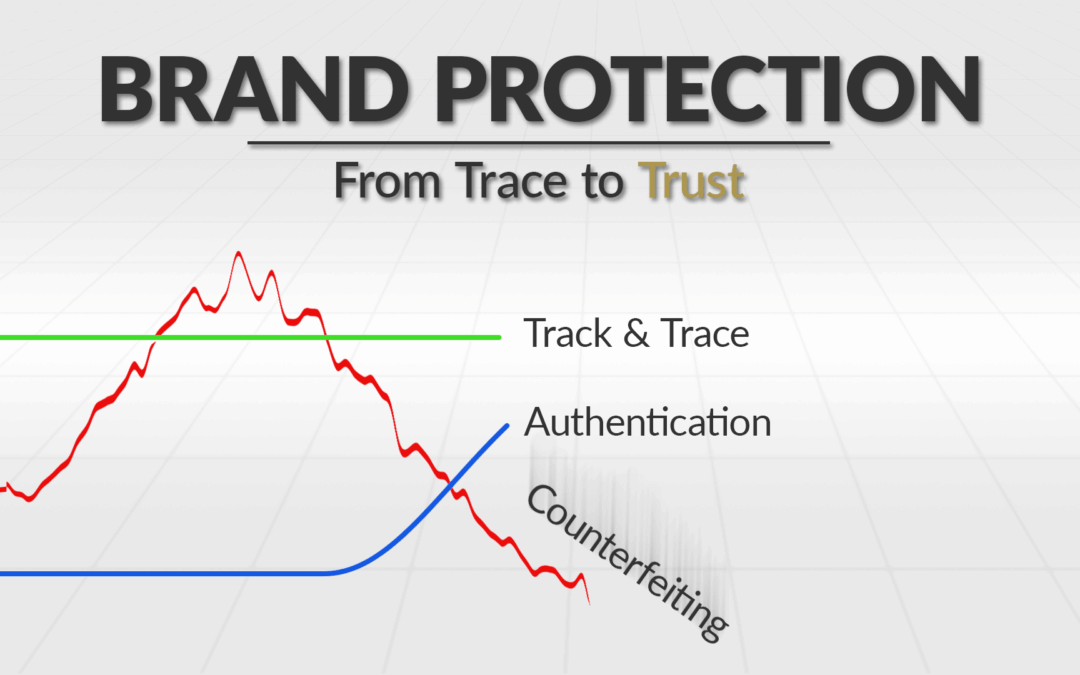
Product traceability helps track batches, supply chain events, and related information. But it can’t always prove that the physical item being scanned is genuine. When identifiers can be copied or reused, brands need authentication alongside traceability.
Businesses use traceability to document supplier and sourcing details, confirm the origin of raw materials, and follow goods from manufacture to sale. It also supports recalls, regulatory compliance, distribution control, and information collection.
The caveat: Traceability records what an identifier says about a material; it doesn’t necessarily prove that the physical product carrying that identifier is genuine. For brands exposed to counterfeiting, traceability should be paired with authentication.
What Is Product Traceability?
Traceability is the ability to identify a raw material, component, or finished unit and follow its movement and associated details from origin through distribution. It creates a digital history linked to a batch or serial number.
In many industries, this record helps businesses trace goods through production, distribution, sale, and, where relevant, return or recall. Depending on the setup, the identifier may be a barcode, QR code, Data Matrix code, serial number, or RFID tag.
How Traceability Works
Traceability works by assigning an identifier to a product or batch and recording supply chain events linked to that identifier. The process typically works as follows:
- Assign an identifier. Apply or assign a batch number, serial number, barcode, QR code, or RFID tag during manufacturing or packaging.
- Connect it to a system. The identifier links to a traceability platform or database containing the relevant information.
- Record relevant events. Authorized users scan or record the identifier to understand the material origin, shipment, receipt, storage, dispensing, sale, return, or recall.
- Update the record. Each event adds information to the materials’ digital record.
- Review the journey. Use the processes to review the information linked to a batch or serial number and see its recorded movement through the supply chain.
Benefits of Product Traceability
Product traceability gives businesses a clearer, more reliable record of their materials as they move through the supply chain. It helps you with:
- Faster, more targeted recalls: Identify the affected batch and focus your response on the relevant items.
- Better quality control: Link quality issues to specific batches, production dates, suppliers, or distribution events.
- Stronger regulatory compliance: Document batch details and relevant movement or handling events to meet industry requirements.
- Improved supply chain visibility: Monitor inventory across locations and identify gaps, delays, unexpected movements, or missing stock.
- Support for grey market diversion: Compare an item’s intended market with where it appears.
- Easier access to information: Authorized suppliers can access information linked to an identifier, such as batch details, expiry dates, status, or handling instructions.
Common Product Traceability Technologies
Product traceability technologies use identifiers, scanning tools, and connected software to track goods and record their movement through distribution routes. Here are the commonly used technologies:
| Traceability technology | How it works | Limitations |
| Barcodes | Link commodities to SKUs, batches, and basic information. | A barcode can be copied onto another package. |
| QR codes | Give users access to linked information, digital history, or online content. | A QR code alone doesn’t prove that the package carrying it is genuine. |
| Data Matrix codes | Carry serial numbers, batch details, and other encoded details in a compact format. | A valid code can be copied and printed on counterfeit packaging. |
| RFID tags | Track goods without requiring a direct line-of-sight scan. | A tag can be removed, reused, or attached to a different item. |
| Serialization | Assign a unique identifier to each package. | A unique identifier does not verify the physical article if it is copied or reused. |
| NFC tags | Let users tap a smartphone to access linked information or a digital history. | An NFC tag alone doesn’t necessarily prove the physical product is genuine. |
The same principles apply across regulated industries, from pharmaceuticals and medical devices to the food industry.
Limitations of Traceability Solutions
Common limitations include the following:
- Identifiers can be copied or reused. A counterfeit can carry a copied barcode, QR code, Data Matrix code, or serial number from the genuine unit. The scan may return valid information even though the object is counterfeit.
- Digital records do not verify the physical item. A traceability system can confirm what its database says about an identifier. It can’t, by itself, confirm that the identifier is attached to the original product, label, or package.
- Traceability depends on consistent processes. Missing scans, incorrect entries, or disconnected suppliers create gaps across supply chains.
- Visibility may decrease after sale. Once your inventory leaves the controlled distribution chains, you may have fewer opportunities to record where it goes or how it is handled.
- Unexpected scans require investigation. A scan from an unusual location, at an unexpected time, or in unusually high volumes can indicate a problem. However, the event log alone may not explain whether the cause is a counterfeit, diversion, or data error.
3 Real-World Incidents That Show Tracking Limitations
The limitations become especially apparent in cases of drug counterfeiting, where a product can carry legitimate-looking identifiers without being genuine. Three recent incidents illustrate the limitation:
1. Manipulated Cancer Medicine Re-entered the Legal Distribution
The European Commission cited a case in which a colon cancer medicine was stolen from hospitals, manipulated, and reintroduced into the legal supply chain under false credentials before being distributed by wholesalers.
The incident shows that paperwork can mislead businesses when the medicine itself has been compromised. Traceability can help investigators reconstruct events, but it cannot by itself confirm that the medicine inside the package is genuine.
2. Counterfeit Mounjaro Used a Legitimate Batch Number
In 2026, counterfeit 15 mg Mounjaro KwikPens reached patients in the United Kingdom. The fake pens used batch number D873576, a legitimate number for genuine 7.5 mg Mounjaro pens.
The UK medicines regulator identified the counterfeits after patients reported faulty pens. The batch number looked legitimate, but it did not prove that the pen, its contents, or its manufacturing conditions were genuine.
3. Counterfeit Ozempic Entered the U.S. Drug Supply Chain
In 2023, the FDA warned consumers that thousands of counterfeit Ozempic units entered the legitimate U.S. drug supply chain. The counterfeits included fake cartons, pen labels, needles, and information designed to look authentic.
This case shows why a product’s appearance, packaging, or supply chain path as proof of authenticity can be deceiving. Traceability can record the information and movement, but it does not verify the physical item itself.
Why Product Traceability Needs Authentication
For brands exposed to counterfeiting, the strongest approach combines both:
- Traceability for information and movement: Track batches, serial numbers, and shipments to understand where products move and where they should appear.
- Authentication for physical proof: Verify that the product, package, label, seal, or component is genuine rather than a counterfeit carrying a copied identifier.
- Monitoring info to identify suspicious activity: Review unusual scans, locations, timing, or repeated checks that may indicate counterfeiting, diversion, or grey-market activity.
- Investigation and enforcement based on reliable evidence: Use traceability and authentication data together to investigate incidents and support enforcement action.
Product Traceability vs. Product Authentication
| Aspect | Product traceability | Product authentication |
| Primary purpose | Records information and supply chain movement. | Verifies that a product, package, label, seal, or component is genuine. |
| Key question | Where has this product been, and where should it be? | Is this physical item authentic? |
| What it verifies | The information linked to a batch number, serial number, or other identifier. | The physical characteristics or security feature of the product itself. |
| Common tools | Data Matrix codes, QR codes, barcodes, RFID tags, and serialization. | Physical security features, covert markers, digital verification features, and product-level authentication technologies. |
| Main value | Supports recalls, compliance, supply chain visibility, and product data management. | Helps detect counterfeit consumer goods, copied identifiers, altered packaging, and product substitution. |
| Main limitation | A copied or reused identifier can still return valid information. | Does not replace supply chain records. |
You get the strongest protection when you use both: traceability to manage information and inventory journey, and authentication to verify the physical item.
How AlpVision Strengthens Product Traceability Programs
AlpVision strengthens product traceability by helping you verify that the physical item linked to a traceability record is genuine. It complements your existing serialization, track-and-trace software, and supply chain databases.
Add Physical Authentication to Your Traceability Program
You can combine your existing traceability code with AlpVision Cryptoglyph on the same package. This helps you confirm that the code is attached to genuine packaging instead of a counterfeit product. Cryptoglyph and Fingerprint add the physical proof that traceability alone cannot provide.
Monitor Suspicious Product Checks
AlpVision’s Brand Monitoring System can combine authentication and traceability to help you identify suspicious activity. You can monitor:
- Unusual scan locations
- Repeated checks of the same product
- Unexpected scan timing
- Patterns that may indicate counterfeiting, diversion, or grey-market activity
This gives your team a stronger starting point for investigations and enforcement.
Support Item-Level Traceability When Needed
AlpVision can also support item-level traceability in specific applications. This requires a unique Cryptoglyph on every package or a unique Fingerprint for every object.
This approach can help you investigate grey-market activity when visible serial codes are unsuitable or likely to be removed. It lets you link an individual item to its record while also verifying that the item is genuine.
Trace the Record, Authenticate the Product
When counterfeiters can borrow the trust attached to your product record, it creates a brand protection problem. A copied code, serial number, or batch number can make a fake product look legitimate to a distributor, retailer, or consumer. When that happens, your brand faces customer safety risks, lost revenue, reputational damage, and a more difficult investigation.
That is why effective brand protection strategies combine traceability with physical authentication. Together, they will give you visibility into distribution while making it harder for counterfeiters to use legitimate information to support a fake.
Contact AlpVision to find the right product authentication solution for your brand.
Contact Us