
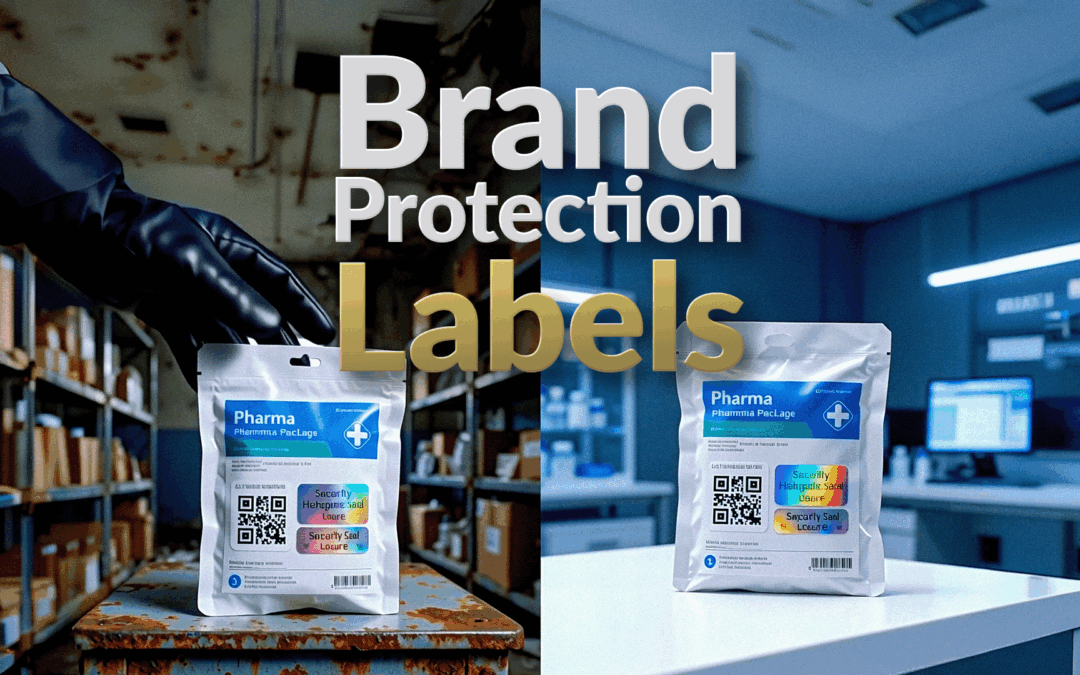
Counterfeiting is growing across every industry. Pharmaceuticals, cosmetics, wine and spirits, and electronics all face higher risks than ever before. Most brands already use brand protection labels, tamper-evident seals, holograms, RFID tags, or QR codes to protect their products. These tools help, but they are no longer enough on their own.
Counterfeiters can easily copy brand protection labels because their security features, such as holograms and QR codes, are visible, predictable, and easy to reproduce. Basic holograms can be imitated with common printing tools. QR codes and serial numbers can be cloned or reapplied.
The wider problem: When the fake labelled product enters the market, the entire protection system fails. Consumers, inspectors, and distributors are misled because the product “looks” secure.
The solution is simple: Protect the label itself with an advanced anti-counterfeiting solution like Cryptoglyph. Every label needs security that counterfeiters can’t see, copy, or remove.
Why Counterfeiters Target Brand Protection Labels First
Counterfeiters target security labels because copying them is often the fastest way to make a fake product look real. Here are three reasons why brand protection labels are the first counterfeit target.
1. Labels Are the First and Weakest Point of Authentication
From a customer’s point of view, a label that looks correct usually means the product is genuine. Counterfeiters use this to their advantage by focusing on duplicating visual elements such as layout, color, arc, and finishing.
A recent example from the cosmetics industry shows how strong this visual trust is. In 2025, South Korean authorities uncovered more than 87,000 fake luxury cosmetics packaged in boxes, containers, and labels that looked identical to the original brands. Distributors said the packaging was so accurate that they couldn’t tell the difference.
Result: For brand owners, the fake products lead to lost sales, customer complaints, safety concerns, and damaged trust.
2. Transparent Seals and Tamper-Evident Labels Are Easy to Imitate
Transparent seals are designed for tamper evidence, not anti-counterfeit protection. Their main purpose is to:
- Show if a package has been opened
- Prevent the reuse of old packaging
Most seals today do only this. They don’t provide true security against counterfeiting.
Because these seals use simple materials, such as clear films, adhesives, and basic printing, counterfeiters can easily copy their appearance. A clean, unbroken seal gives customers and inspectors the impression that the product is safe, even when it is not. Even the simplest transparent tamper-proof seal can be faked, along with regulated packaging like GHS hazard labels.
Risks Caused by Counterfeit Seals
Counterfeit seals give rise to two-fold problems:
- A counterfeit package with a copied seal: Counterfeiters can apply a fake transparent seal to a fake package. At a glance, the product looks untouched and legitimate.
- A genuine package with a replaced seal: Counterfeiters can open a real package, remove the original medicine, insert fake tablets, and apply a new counterfeit seal. The package still appears factory-closed.
The 2022 Gilead case in the United States shows how serious this can be. Gilead uncovered a large counterfeiting scheme involving its HIV medicines. Criminals obtained authentic Gilead vials, broke the tamper-evident seals, removed the real medication, inserted foreign tablets, and re-sealed the vials.
Because the bottles, labels, and codes were original, pharmacies accepted the products as genuine, risking patient safety. The scale was significant: more than 85,000 counterfeit vials, valued at over $250 million, entered the U.S. supply chain before the scheme was exposed.
3. Serialization, Barcodes, and QR Codes Can Be Cloned
Digital identifiers such as QR codes and serial numbers are helpful, but they aren’t unique barriers. Counterfeiters replicate the same code on thousands of fake products, making it appear valid to basic scanning systems. Without a covert protection layer behind the code, duplication is simple and fast.
The electronics sector shows how far this can go. In a major 2024 counterfeit Cisco case, criminals imported low-quality networking devices and added fake Cisco hologram labels, serial number stickers, documentation, and packaging. Because the labels and serial identifiers looked real, hospitals, schools, and government organizations unknowingly bought counterfeit equipment.
This demonstrates how easily counterfeiters can replicate or fake digital identity markers, making surface-level checks unreliable.
What Makes a Strong Brand Protection Label?
A strong brand protection label combines physical, overt, and covert security elements. Each layer serves a different purpose, and together they create a label that is much harder for counterfeiters to copy or misuse.
1. Physical Tamper Evidence
Physical tamper evidence shows when a product has been opened or interfered with. It provides a first line of defense, but should not be the only protection. Non-refillable closure in spirits is an example. Here’s why physical options need to be used:
- Transparent tamper-proof seals: While it’s simple and widely used, but easy for counterfeiters to copy or replace.
- VOID labels: They leave a clear message when peeled away, making tampering visible.
- Frangible materials: They apart when lifted or removed, preventing clean re-application.
Physical features help, but they can be imitated or bypassed if used alone. For example, some brands use security tape as a basic tamper-evident layer, but tape can be copied or replaced if counterfeiters access similar materials.
2. Overt Security Features
Overt features are visible elements that help customers and inspectors verify authenticity at a glance. They support trust but do not stop determined counterfeiters. Here are some examples and options:
- Holograms: Eye-catching and familiar, but widely replicated in counterfeit packaging.
- Optical variable ink (OVI): Optical variable inks change appearance at different light angles, adding a simple visual check.
- QR codes: Useful for engagement and verification, but easy to clone without additional security behind them.
- Thermal labels: Commonly used for variable data and barcodes, but thermal labels can be copied or reprinted unless the label itself carries covert protection.
Overt features help with quick inspection, but counterfeiters often copy what they can see. Counterfeiters often add fake certified marks or quality stamps to make their packaging look legitimate. Whether the label is made of film, foil, or paper, the visible surface alone cannot stop a counterfeiter. Even custom holograms or specialty print effects can be copied when counterfeiters have access to the right tools.
Covert Security Features
Covert anti-counterfeiting features are hidden elements that counterfeiters can’t detect. These features are critical because they provide true, reliable authentication even when a fake label looks perfect. Covert features carry the following signs:
- Invisible markers: Applied during printing and only detectable with the right tools. These hidden markers support reliable verification without changing how the seal works.
- Micro-patterns: Tiny printed structures that are impossible to reproduce accurately.
- Forensic identifiers: Highly specialized signatures used for high-risk products.
Why Traditional Anti-Counterfeiting Methods Are No Longer Enough
Traditional security features, especially those that are visible or easy to access, no longer stop modern counterfeiters. Criminals have advanced printing tools, digital design software, and global access to materials. When these tools are combined, they allow counterfeiters to copy packaging and labels with a level of accuracy that was not possible a decade ago. As a result, basic security features no longer provide reliable protection on their own.
Key weaknesses of traditional anti-counterfeiting solutions include:
- Holograms are widely copied. High-resolution imaging and foil reproduction have made fake holograms common.
- QR codes and serial numbers are easily cloned. Counterfeiters copy one real code and print it on thousands of fake products.
- Industrial-grade printers allow precise duplication. Modern equipment lets counterfeiters match the color, layouts, fonts, and finish with near-perfect accuracy.
Here are the strengths and weaknesses of common features:
| Anti-counterfeiting feature | Strength | Weakness |
| Holograms | Easy for consumers to check | Easily copied with common printing tools |
| QR codes | Good for engagement and verification | Can be duplicated or redirected |
| Tamper-proof seals | Provide physical evidence of opening | Visual copies are simple to imitate |
Cryptoglyph: The No-Brainer Solution for Counterfeit-Proof Labels
Cryptoglyph is a covert digital marker embedded into the microstructure of the printed design. It is completely invisible to the human eye. It works with any printing technology, using standard inks and varnishes, requiring no special materials, films, or equipment.
Cryptoglyph protects the label itself. What’s more, it works across a wide range of packaging components, including transparent tamper-evident seals, folding cartons, blister packs, inserts, leaflets, and device labels. Here’s why it remains the unbeatable solution for anti-counterfeiting:
1. It’s Impossible to Copy
Counterfeiters copy what they can see. They can’t copy what they cannot detect.
- Cryptoglyph uses randomized microstructures that follow no predictable pattern.
- Any attempt to copy, scan, or reprint the label breaks the microstructure.
- Fake products are detected instantly because the hidden pattern is missing or incorrect.
- Counterfeiters can’t reverse-engineer the feature because they cannot see it, measure it, or isolate it.
This gives brands a reliable digital proof of authenticity that survives every type of visual or material imitation.
2. It Provides Instant, Scalable Authentication
Cryptoglyph is designed for real-world use where speed and volume matter.
- You can verify the product with a standard smartphone.
- The system supports millions of products with no change to production lines.
- It delivers strong protection for multiple industries, including healthcare, luxury goods, cosmetics, electronics, and consumer packaged goods.
3. It’s Perfect for Transparent Seals
Transparent seals are a major target for counterfeiters. Cryptoglyph protects them without changing their look or behavior.
- The feature is invisible and aesthetics-neutral.
- It does not affect adhesive performance or tamper behavior.
- No visible elements, holograms, inks, or designs are added.
- Cryptoglyph works even when the seal is fully transparent.
Case Example: Protecting Transparent Vial Seals
Let’s take an example of how Cryptoglyph can fight against pharmaceutical counterfeiting. Even if counterfeiters manage to copy the physical appearance of the seal, their fakes would fail the simple smartphone authentication because the hidden micro-dot pattern would be missing.
Inspectors can intercept the counterfeit shipments before they reach hospitals, preventing patient risk and brand damage.
Cryptoglyph-protected high security seals are also available through Schreiner MediPharm, AlpVision’s trusted partner that produces advanced tamper-evident solutions such as the Tamper-Evident Security Seal (TESS).
How to Implement Brand Protection Labels with Cryptoglyph
Implementing Cryptoglyph is simple and fits directly into your existing production setup:
- Assess vulnerabilities: Identify where your current labels and seals are exposed.
- Choose label types: Select which components to secure, transparent seals, pressure-sensitive labels, cartons, blisters, inserts, or device labels.
- Embed Cryptoglyph: AlpVision adds the Cryptoglyph feature to your existing label and seal files before production.
- Print as usual: Run production on your current equipment using standard inks—no process changes required.
- Deploy authentication tools: Provide the smartphone verification app to your internal teams.
- Train inspectors and partners: Ensure supply chain, QA, and field teams know how to authenticate products. You can also provide short video guides to help inspectors and partners understand how to verify products using the smartphone app.
The best part: Cryptoglyph requires no new equipment, no special ink, and zero CAPEX. It fits directly into your existing printing and labeling process.
Every Label Can Be Protected Against Counterfeiting and Tampering with AlpVision
Counterfeiters copy labels because it is the easiest way to make a fake product look real. And when fake products are sold at a real product’s price, you lose revenue, trust, and control of your market. This is why your labels and seals need protection of their own. Even if you’re deploying brand protection services, your labels will need additional security.
AlpVision’s packaging and labeling solution provides that protection technology. Cryptoglyph adds a covert, invisible digital marker into your existing labels and seals, giving your packaging a secure layer of counterfeit protection. It works on all major packaging components used in healthcare and multiple other industries.
AlpVision has supported global brands for many years by securing folding boxes, blisters, labels, medical devices, and containers. Today, that same protection extends to transparent tamper-evident seals, produced through trusted partners such as Schreiner MediPharm, creators of the Tamper-Evident Security Seal, leading developers of innovative tamper-evident security seals for the pharma industry.
Every label and every seal can now be made protected against counterfeiting with only minor adaptation or even without changing your production process. Protect your labels before counterfeiters copy them. Reach out to AlpVision to explore Cryptoglyph-secured seals.
Contact Us