
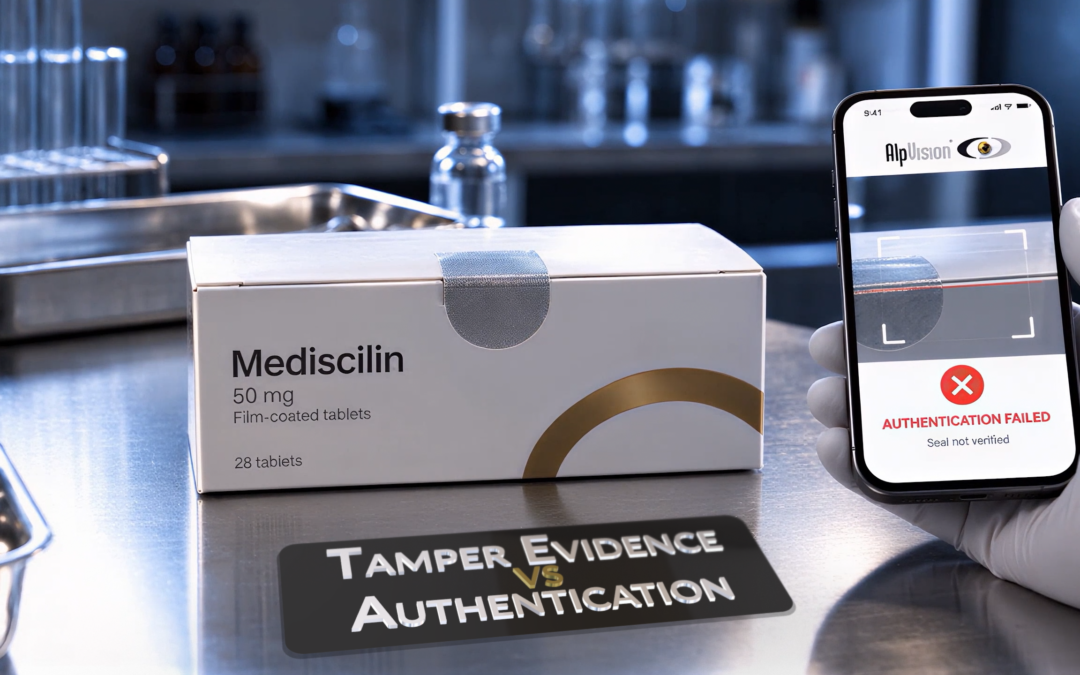
Tamper evidence and authentication are not the same. Tamper evidence tells you whether a package may have been opened or altered. Authentication verifies whether the product, packaging, or security feature is genuine. But what happens when a counterfeit product carries a seal that looks untouched?
An intact tamper seal therefore tells only part of the story. A counterfeit product can carry a fake, unbroken seal, while genuine packaging can be opened, refilled, and resealed. Authentication fills this gap by verifying the seal or packaging itself.
In this article, we explain where each approach works, where it falls short, and how combining them can provide stronger product protection.
Tamper Evidence vs. Authentication: Differences
Before examining each approach in detail, here’s a quick comparison of tamper evidence and authentication:
| Factor | Tamper evidence | Authentication |
| Main question | Does the package show signs of opening or interference? | Is the product, packaging, or security feature genuine? |
| Main purpose | Reveal possible tampering | Distinguish genuine products from counterfeits |
| Threat addressed | Opening, removal, alteration, or refilling | Copying, substitution, forgery, or unauthorized production |
| How it works | Leaves visible or physical evidence when breached | Verifies a security feature against a genuine reference or system |
| Typical result | Intact, broken, missing, or altered | Genuine, counterfeit, or inconclusive |
| Examples | Breakable seals, VOID labels, shrink bands, and induction seals | Invisible markings, material fingerprints, secure codes, and taggants |
| Main limitation | An intact seal may still be counterfeit | Authentication may not show whether a genuine package was opened |
What Is Tamper Evidence?
Tamper evidence is a visible or physical sign that a package, seal, or closure may have been opened, removed, or altered. The sign could be a broken band, torn label, exposed message, damaged film, or missing seal. Strictly speaking, tamper evidence is the sign left behind, while a tamper-evident feature is the mechanism designed to create that sign.
For example, the FDA under U.S. regulations defines tamper-evident packaging as packaging with an indicator or barrier that, if breached or missing, can reasonably be expected to provide visible evidence of tampering. It also requires relevant OTC packaging features to remain intact through normal manufacturing.
At its simplest, tamper evidence helps answer: Does the package show signs that someone may have accessed the product? It can’t prove exactly what happened, but it can show that a barrier was broken, removed, or altered.
What Are Tamper-Evident Labels and Packaging?
Tamper-evident labels or brand protection labels are adhesive features applied across an opening, closure, or removable component. They may tear, break apart, or leave a VOID message when removed.
Tamper-evident packaging uses the package or closure itself to reveal interference, such as a broken safety band, damaged induction seal, torn perforation, or opened film wrapper.
Examples of Tamper-Evident Features
Common examples include:
- Breakable seals: Tear or separate when the package is opened.
- VOID labels and tapes: Leave behind a message or pattern when removed.
- Destructible labels: Break into pieces when someone tries to peel them away.
- Shrink bands and film wrappers: Must be cut or torn to access the closure or product.
- Induction seals: Create a barrier across the container opening that must be broken or removed before use.
- Breakaway caps and bands: Separate from the closure during the first opening.
- Perforated cartons: Tear along a defined section when the package is opened.
- Non-refillable closures with tamper-evident components: Restrict refilling while using breakaway bands or other indicators to reveal interference.
Tamper-Evident vs. Tamper-Proof vs. Tamper-Resistant
The examples above may be described as tamper-evident, tamper-resistant, or even tamper-proof. Although these terms are often used interchangeably, they describe different levels and types of protection:
| Term | What it means | Question it answers |
| Tamper-evident | Leaves a visible or physical sign when a package is opened or altered | Does the package show evidence of interference? |
| Tamper-proof | Suggests that tampering is impossible | Can tampering be prevented completely? |
| Tamper-resistant | Makes opening, removal, or interference more difficult | Is the package designed to resist tampering? |
“Tamper-proof” is usually a marketing term rather than a realistic technical claim. A determined person may still bypass, damage, copy, or replace a physical security feature. Brands should describe what the feature actually does instead of implying that tampering is impossible.
Advantages of Tamper Evidence
Tamper-evident features provide several practical benefits:
- Immediate warning: A broken, missing, or altered feature alerts users that the package may have been compromised.
- Simple inspection: Consumers, retailers, and supply chain teams can usually check the feature without equipment.
- Manufacturing flexibility: Brands can choose from labels, films, seals, closures, and structural packaging designs according to the product.
What Is Product Authentication?
Product authentication is the process of verifying whether a product, package, or security feature is genuine. It answers the question: Is this the product the brand originally manufactured or authorized?
Identification alone is not always authentication. A serial number or QR code may identify an item, but a counterfeiter can copy that identifier and place it on a fake product. For reliable authentication, the feature must be securely connected to the physical item being checked.
What Can Be Authenticated?
Authentication can apply to different parts of a product:
- The product itself: Useful when packaging can be removed, replaced, or reused.
- The packaging: Suitable when the carton, label, or printed material is the main counterfeit target.
- The seal or closure: Confirms whether the tamper-evident component is genuine.
- A component: Helps detect substituted or unauthorized parts in electronics, automotive products, and industrial equipment.
- The contents: May require chemical, forensic, or product-specific testing.
Types of Product Authentication Technologies
Product authentication technologies are generally classified according to how the feature is detected:
- Overt authentication: Uses visible features that consumers or inspectors can check without specialized equipment. Examples include holograms, color-shifting inks, and security graphics.
- Covert authentication: Uses hidden features that require a smartphone, reader, light source, or another method for detection. These features conceal the authentication mechanism from counterfeiters.
- Forensic authentication: Uses chemical, molecular, DNA, or other specialized features that require laboratory analysis. It is generally used for high-risk investigations or when evidentiary confirmation is required.
- Digital authentication: Uses a device and verification system to check a product. QR NFC tags, digital watermarks, and smartphone-readable security features can connect the physical item to a database or cloud platform.
These categories can overlap. AlpVision Cryptoglyph, for example, combines covert and digital authentication. It adds an invisible pattern of microscopic dots to printed packaging, labels, or seals. A smartphone application detects the pattern and verifies whether the printed component is genuine.
Is Serialization the Same as Authentication?
Serialization gives each product or package a unique identifier. It helps you distinguish individual items, record supply-chain events, and detect the same number appearing in unexpected locations.
However, serialization doesn’t automatically prove that a product is genuine. A counterfeiter can copy a valid serial number and apply it to a fake product. Serialization provides stronger protection when the identifier is connected to a physical security feature that cannot be easily copied or transferred.
Benefits of Product Authentication
Product authentication provides several benefits when you need to distinguish genuine products from convincing copies:
- Clearer verification: Digital systems and detection tools can provide a consistent result instead of relying only on appearance.
- Protection against copied packaging: Authentication can detect a fake even when its design closely matches the genuine product.
- Flexible user access: Depending on the technology, consumers or authorized teams can perform checks at different points in the supply chain.
- Product-level protection: You can authenticate the product or component itself when packaging protection is not enough.
- Counterfeit intelligence: Connected systems can record authentication results and help identify suspicious products, locations, or distribution patterns.
Limitations of Tamper Evidence: Why Tamper-Evident Packaging Alone Isn’t Enough
Tamper evidence is useful, but it does not answer every product-security question:
- It does not prove authenticity: A counterfeit product can carry a copied seal that appears intact.
- The feature may be replaced: Someone may remove the original seal and apply a counterfeit replacement after refilling or substituting the contents.
- It only protects specific entry points: A seal on the cap does not reveal interference through the bottom, side, or another part of the package.
- It relies on inspection: Users must notice the feature, know what to check, and act when it appears damaged or missing.
- Normal damage can create uncertainty: Distribution, handling, heat, or moisture may damage some features without deliberate tampering.
- It may not provide a digital record: A physical indicator shows the condition of the package but does not usually record when or where the interference occurred.
Tamper evidence can warn you that a package may have been compromised. To determine whether the seal, packaging, or product is genuine, you also need authentication.
Limitations of Product Authentication: Why Authentication Alone Isn’t Enough
Authentication is only effective when the correct element is protected, and users can check it reliably:
- It only verifies the protected element: Authenticating a genuine carton does not prove that the contents have not been replaced.
- It may require a tool: Users may need a smartphone, reader, application, light source, or laboratory test.
- Visible identifiers may be copied: Standard QR codes, serial numbers, and visual features can be reproduced unless they include additional protection.
- It does not always reveal tampering: A genuine product or package may authenticate successfully even after someone has opened or altered it.
- Implementation matters: The feature must remain secure, readable, and connected to the product throughout manufacturing and distribution.
Why Tamper Evidence and Authentication Work Better Together
Tamper evidence and authentication work better together because each covers a gap left by the other. Tamper evidence shows whether a package may have been opened or altered, but it can’t prove that the seal or product itself is genuine. Authentication verifies that genuineness.
Combining them allows users to check two things:
- Is the package intact?
- Is the protected product, packaging, or seal itself genuine?
This helps detect both common attack methods: Authentication can identify a counterfeit product with an intact fake seal, while tamper evidence can reveal interference with genuine packaging that still passes authentication.
The combination also makes counterfeiting more difficult. A counterfeiter must reproduce the authentication feature while avoiding any visible evidence of opening or substitution. You therefore receive stronger protection against copied packaging, replacement seals, refilling, and product substitution.
Case in point: EU pharmaceutical regulations require most prescription medicines to carry both a unique identifier for authentication and an anti-tampering device. This reflects the fact that authentication and tamper evidence address different risks.
Applications of Tamper Evidence and Authentication by Industry
The industry alone does not determine the right protection. You also need to consider how counterfeiters access the product, which components they copy, and whether genuine packaging can be reused.
The table below provides a starting point:
| Industry | Common attack | Use tamper evidence to protect | Authenticate |
| Pharmaceuticals | Opening packages, replacing medicine, and resealing containers | Cartons, bottle openings, blister packs, and closures | The seal, packaging, and product where necessary |
| Wine and spirits | Refilling genuine bottles and replacing closures or capsules | Caps, capsules, and bottle closures | The closure, capsule, label, or bottle |
| Cosmetics | Refilling containers, substituting contents, and copying packaging | Cartons, jars, bottles, and caps | The seal, packaging, or container |
| Food and beverage | Opening, adulterating, refilling, or replacing products | Container openings, lids, films, and breakaway bands | The closure, label, or packaging |
| Electronics | Opening devices, replacing components, and relabeling products | Device enclosures, boxes, ports, and access points | The device, label, or individual component |
| Industrial products | Substituting parts, reusing packaging, and installing unauthorized components | Containers, housings, and protected access points | The component or part itself |
These recommendations are starting points rather than fixed rules. A pharmaceutical carton, for example, may be genuine while the medicine inside has been replaced. A genuine spirits bottle may also be refilled and fitted with a counterfeit closure. High-risk products may therefore require protection on more than one component.
How Tamper Evidence and Authentication Work in Real Life
The value of combining tamper evidence and authentication becomes clearer when you apply it to a specific attack. The following examples from the spirits and pharmaceutical industries show how counterfeiters can make a compromised product appear unopened:
Spirits: Preventing Refill Fraud
For premium spirits, brands need to detect first opening and confirm that the capsule has not been replaced with a counterfeit.
- The attack: Counterfeiters collect genuine empty bottles, refill them with cheaper substitutes, and apply replacement capsules.
- What tamper evidence does: A destruction-on-open capsule breaks when the bottle is opened. However, a replacement capsule may make the bottle appear unopened again.
- How authentication helps: Cryptoglyph adds an invisible authentication feature to the original capsule. A smartphone can confirm whether the capsule is genuine, even when a replacement looks visually convincing.
- The result: The capsule must appear intact and pass authentication. A counterfeit replacement may copy the design, but it will not contain the genuine Cryptoglyph feature.
Pharmaceuticals: Detecting Fraudulent Resealing
For pharmaceutical packaging, the seal needs to reveal first opening while allowing users to confirm that it is still the original seal.
- The attack: A fraudster cuts a transparent seal, accesses or replaces the medicine, and places a second transparent seal over the damaged area.
- What tamper evidence does: The original seal provides evidence of first opening, but an additional transparent layer may hide the damage during a quick visual check.
- How authentication helps: Cryptoglyph is embedded into the original transparent seal. If another layer is placed over it, the smartphone application can no longer read the feature correctly. A complete counterfeit replacement will also fail authentication because it does not contain the genuine Cryptoglyph pattern.
- The result: Users can check both the physical condition and authenticity of the seal, making fraudulent resealing easier to detect.
Add Authentication to Tamper-Evident Packaging with AlpVision
Tamper evidence and authentication are most effective when each addresses the risk it’s designed to detect. The key takeaway is to protect every realistic point of entry without adding unnecessary complexity. AlpVision’s anti-counterfeiting solutions support this approach for both printed packaging and physical products:
- AlpVision Cryptoglyph: Adds an invisible, smartphone-authenticated feature to tamper-evident seals, capsules, labels, and printed packaging. It verifies that the component is original, even when a replacement looks convincing.
- AlpVision Fingerprint: Uses naturally occurring surface irregularities to authenticate suitable products, closures, and components without adding a marking. It provides product-level verification when protecting the packaging alone is not enough.
- Brand monitoring system: Records product checks and can help brands identify failed authentications, suspicious locations, and possible counterfeit distribution.
The right combination depends on how your specific product could be opened, refilled, substituted, or repackaged, and which components must be checked to expose the attack.
Want to add authentication to your tamper-evident packaging? Contact AlpVision to discuss whether Cryptoglyph, Fingerprint, or a combination of both is right for your products and supply chain.
Contact Us